Table of Contents
- Why Filament, and why now
- The architecture I reach for
- Designing resources that scale
- Roles, permissions, and multi-tenant isolation
- Reports, exports, and audit trails
- Performance considerations on large datasets
- Arabic / RTL support for GCC enterprises
- Frequently asked questions
Introduction
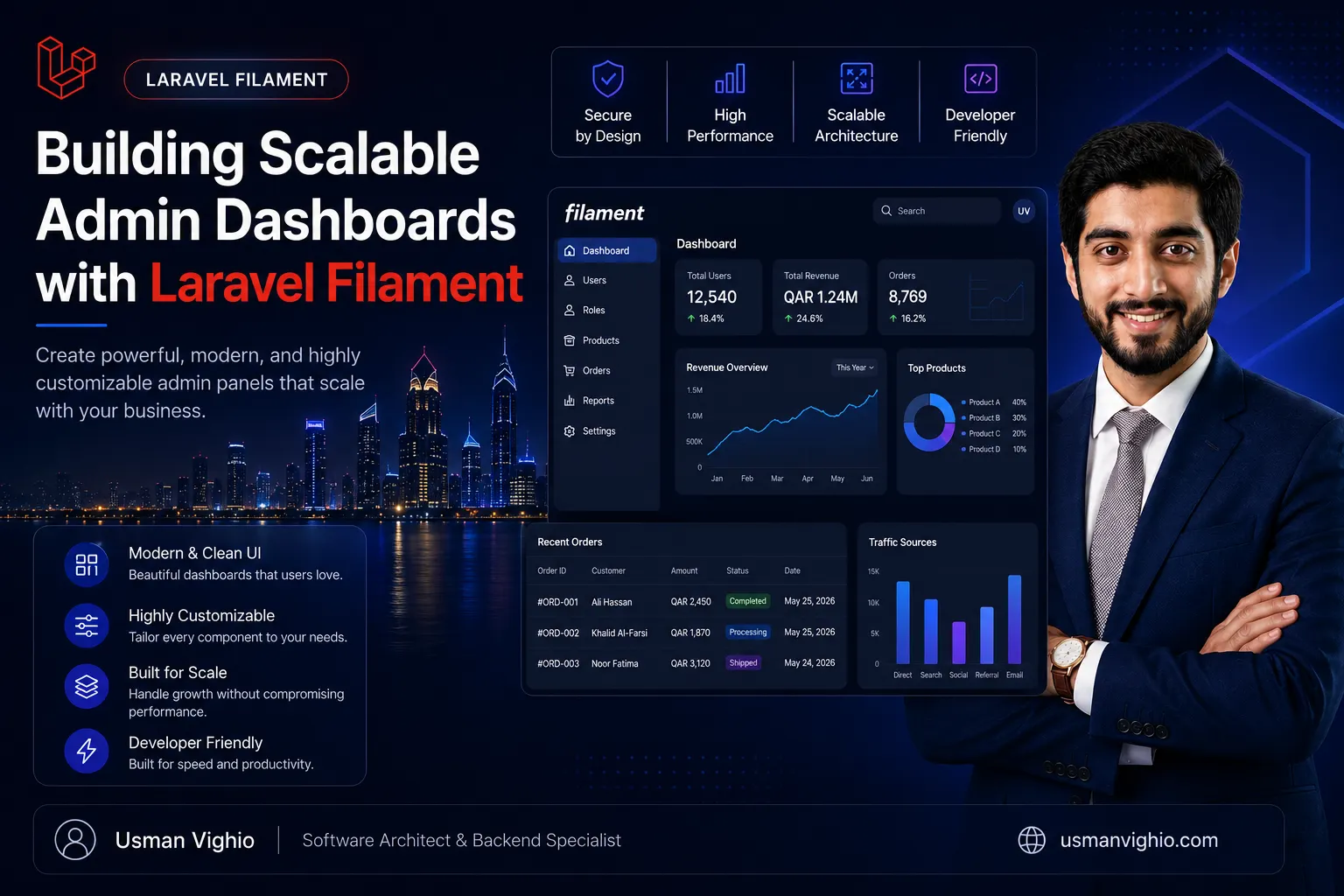
Most enterprise software is, fundamentally, a CRUD interface with rules. The product team obsesses over the consumer-facing storefront or the mobile app, but the system that decides whether the business actually runs is the admin panel — the place where operations staff approve orders, edit inventory, run reports, and handle the messy real-world cases that nobody captures in the original spec. For the past two years, my default tool for building those admin panels has been Laravel Filament, and the gap between Filament and the alternatives keeps widening.
Filament gets a few things right that matter enormously in enterprise work. The resource-based architecture maps cleanly to how operations teams think about their data — “orders”, “customers”, “invoices” — rather than forcing the team to learn an abstract admin metaphor. The permission story integrates out of the box with spatie/laravel-permission, so your roles become real, enforced boundaries instead of comments in a spec doc. And the delivery speed is genuinely transformative: an admin panel that would have taken three weeks to build with a hand-rolled Blade UI now takes a week, and the result is more polished, more accessible, and easier to maintain.
This post is the playbook I follow when building Filament admin panels for GCC enterprises. It covers the architecture decisions that determine whether a Filament panel scales gracefully or becomes the most-hated app in the company. If you want to discuss a specific build, see the Filament dashboards service page or jump to contact.
Why Filament, and why now
Section to be expanded — Filament v3 maturity, ecosystem state in 2026, and why the alternatives (Backpack, Nova, hand-rolled) underperform for typical GCC enterprise workloads.
The architecture I reach for
Section to be expanded — recommended folder structure, resource layout, form/table component patterns, and the relationship to the underlying Laravel backend.
Designing resources that scale
Section to be expanded — when to split resources, when to use relation managers, and how to keep the panel navigable past 30+ resources.
Roles, permissions, and multi-tenant isolation
Section to be expanded — patterns for tenant scoping, super-admin escalation, and audit-ready permission models.
Reports, exports, and audit trails
Section to be expanded — Excel exports, PDF reports, and the audit trail patterns I use for compliance with Qatar PDPL and similar regulations.
Performance considerations on large datasets
Section to be expanded — eager loading, indexed filters, and the specific Livewire-related pitfalls that hurt Filament panels at scale.
Arabic / RTL support for GCC enterprises
Section to be expanded — how to deliver a fully Arabic admin panel that operations teams in Doha, Riyadh, and Dubai can use natively.
Frequently asked questions
Detailed answers to be expanded; FAQ schema is already wired. For mobile-side integration, see the Flutter service.