Table of Contents
- The GCC enterprise context
- Time-to-market: why opinionated wins
- Hiring market reality in Qatar & the GCC
- Scalability in practice
- Security and compliance posture
- Total cost of ownership
- When Laravel is the wrong choice
- Frequently asked questions
Introduction
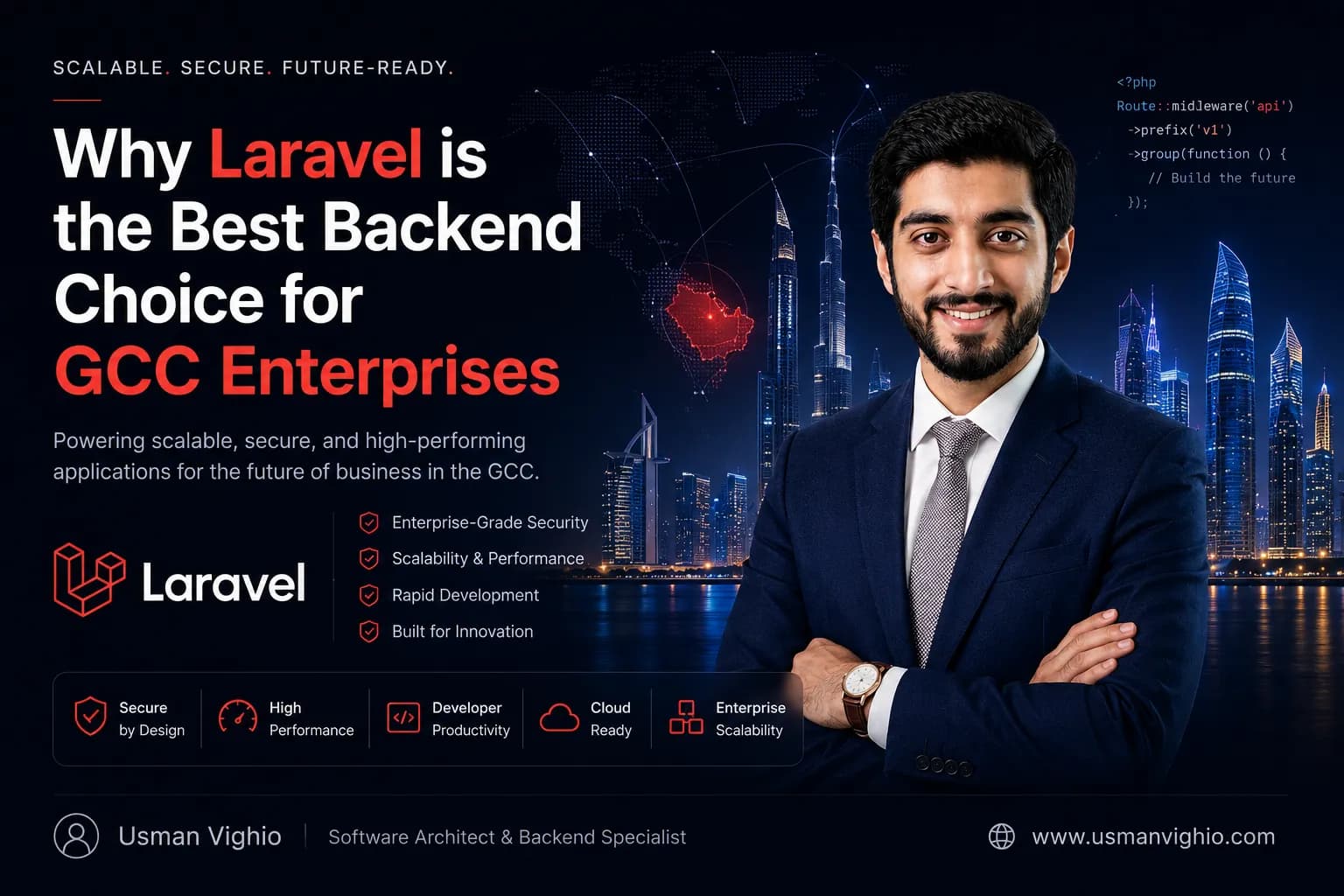
Almost every enterprise build starts with the same question: which backend stack do we commit to? In the GCC — and in Qatar specifically — that question is too often answered by following whichever framework happens to be loudest in international tech media. The result is enterprises picking stacks that look modern on a slide deck but cost three times what they should to deliver, scale, and maintain. After five years of building production backends for clients across Estonia, the GCC, and beyond, I keep arriving at the same conclusion: for the majority of enterprise workloads in this region, Laravel is the right call.
That's not a fashionable answer. Laravel doesn't trend on Hacker News. It doesn't feature in the latest reactive-edge-runtime benchmarks. But none of those things matter for the workload that actually makes up most enterprise software in Qatar and the wider GCC: CRUD-heavy operations systems, multi-tenant SaaS, REST APIs feeding mobile apps, and admin panels with role-based access. Those workloads are exactly what Laravel was designed for, and the ecosystem around it — including Filament for admin interfaces, Sanctum for API auth, and Horizon for queue workers — means a senior engineer can ship a production-grade enterprise system in weeks, not quarters.
This post lays out the case in detail: why Laravel beats the more fashionable alternatives for GCC enterprise work, where it falls down, and how to evaluate whether it fits your specific build. If you'd rather discuss your project directly, see the Laravel backend service page or go to contact.
The GCC enterprise context
Section to be expanded — regulatory, hiring, and procurement realities specific to Qatar and the GCC. Reference the full-stack service for end-to-end engagements.
Time-to-market: why opinionated wins
Section to be expanded — Laravel's convention-over-configuration benefit translated into delivery weeks.
Hiring market reality in Qatar & the GCC
Section to be expanded — comparing the depth of senior PHP/Laravel talent vs. Node/Go/Python in this region.
Scalability in practice
Section to be expanded — Horizon, Redis, queue workers, read replicas, and a real-world scaling story from one of my projects.
Security and compliance posture
Section to be expanded — covering Qatar PDPL, KSA NDMO, UAE PDPL, and how Laravel's ecosystem makes compliance achievable without exotic tooling.
Total cost of ownership
Section to be expanded — a comparison spreadsheet across 3-year TCO for a typical GCC enterprise project on Laravel vs. Node vs. .NET.
When Laravel is the wrong choice
Section to be expanded — honest assessment of where Laravel doesn't fit (heavy real-time, ML inference paths, etc.).
Frequently asked questions
Detailed answers to be expanded; FAQ schema is already wired. See the Filament dashboards service for the admin-side companion to this stack.