About
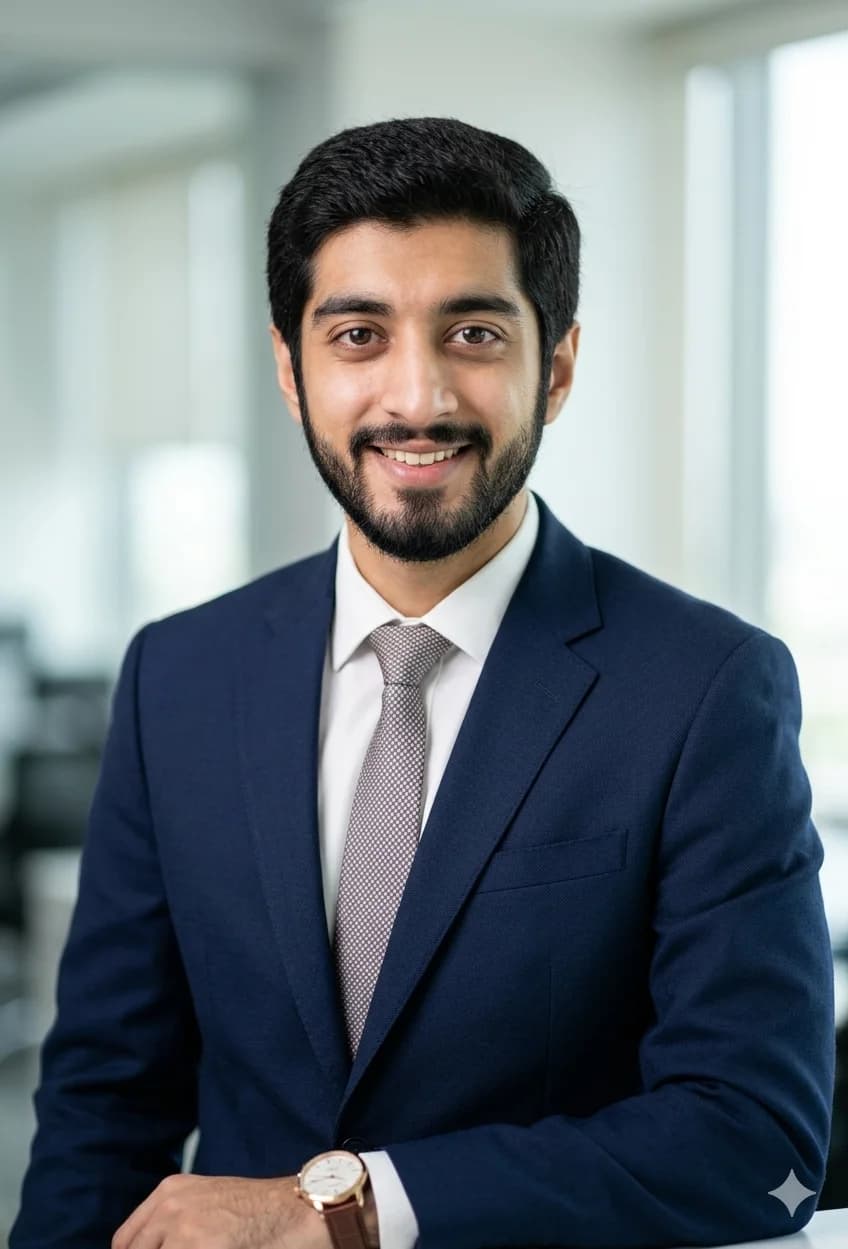
Senior Software Engineer based in Doha, Qatar
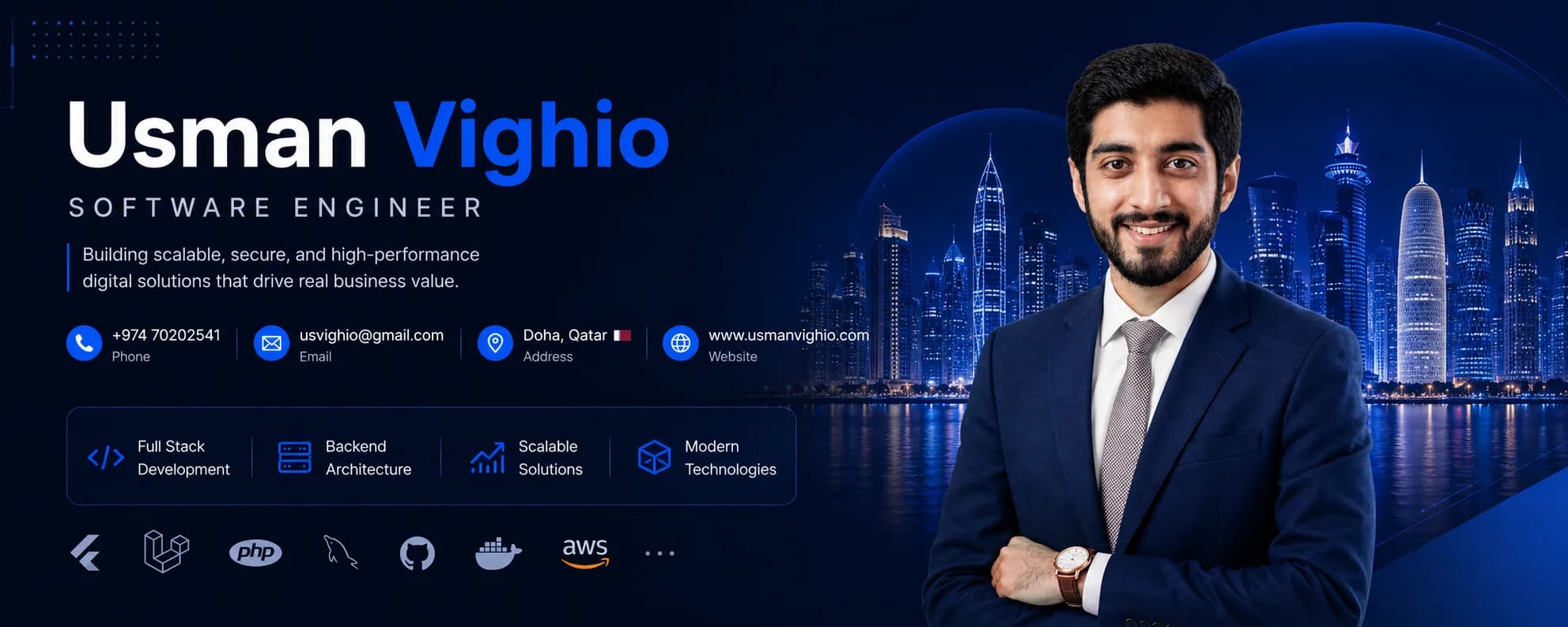
I'm Usman Vighio — a senior software engineer and technical lead based in Doha. I architect and ship enterprise-grade systems, SaaS platforms, mobile applications, and advanced analytics dashboards for clients across Qatar and the GCC, scaling with a trusted team when the project demands it.
- BE Software Engineering — QUEST, Pakistan
- Top 3 of batch · 3.84 / 4.0 CGPA
- Certified Software Engineer (PEC)
- Shipping production systems since 2021
Over five years, I've delivered production systems for governments, multi-branch enterprises, marketplaces, HR teams, and SaaS founders. I lead engagements end-to-end — architecture, build, deployment, and ongoing operation — and bring in trusted engineers, designers, and QA when a project's scope or timeline requires a team. Every system I've shipped is still operating today, and that's the metric I care about.
01
Background
My core stack is Flutter for mobile, Laravel for backends and SaaS APIs, Filament for advanced analytics and admin dashboards, and MySQL underneath. For web applications, I also build with Next.js — primarily for clients who need fast, SEO-optimized frontends or server-rendered experiences alongside their core platform.
I work with clients across Qatar, Saudi Arabia, the UAE, Kuwait, Bahrain, and Oman, as well as internationally — including projects in Europe, South Asia, and beyond. My delivery model is flexible: solo as the senior engineer for focused builds, or as the technical lead of a hand-picked team for larger SaaS and enterprise programs.
I came up the hard way — compliance-grade systems for government and enterprise clients in countries like Estonia, Qatar, and Pakistan; multi-branch ERP deployments for businesses spanning retail, services, and operations that previously ran on spreadsheets and WhatsApp; and HRMS rollouts where payroll had to be correct on day one. None of that work tolerated half-measures.
Formally, I hold a Bachelor of Engineering in Software Engineering from Quaid-e-Awam University of Engineering, Science and Technology in Pakistan — graduated in 2024, ranked 3rd in my batch with a 3.84 / 4.0 CGPA — and I'm a PEC-certified software engineer. The degree gave me the foundation; the production systems I started shipping in my first year of university, in 2021, are what taught me how to ship.
02
How I work
Every engagement follows the same arc — discovery, architecture, build, ship, and operate. For focused builds I run the entire stack myself. For larger SaaS or enterprise programs I act as the technical lead — defining architecture, breaking down work, and coordinating engineers, designers, and QA — while staying hands-on with the critical paths. I don't disappear after launch; the systems I build are the systems I run, and most clients stay with me for years.
Discovery & architecture
Before I write any code, I map the workflow your team actually has — not the workflow your spec describes. Database schema, API contracts, role boundaries, and edge cases get written down first.
Full-stack build
Laravel for the backend and APIs, Flutter for mobile, Filament for the admin. Same engineer, same standards, no integration gaps between layers.
Testing & debugging
Platform-specific iOS and Android testing, API contract verification, real-data load testing. I stay until production data flows through cleanly.
Deployment & optimization
Production deployment on hardened Linux, queue workers under Horizon, query tuning when slow paths appear. I own the production environment, not just the code.
Ongoing operation
Monitoring, incident response, and feature iteration. The work doesn't end at launch — it begins there.
03
Engineering principles
Architecture first
I write the data model and API contracts before a single screen. Cheaper to change a diagram than a deployed system.
Full ownership
Concept to production, with no hand-offs that lose context. One engineer accountable for the whole stack.
Production realism
Every feature is built imagining real data, real users, and real failure modes. No happy-path-only code.
Senior judgement
I tell clients when a feature is wrong before I build it. Easier than rewriting six weeks later.
04
Working with Qatar & GCC clients
Working in the GCC has its own rhythm. Procurement cycles, regulatory requirements (Qatar PDPL, KSA NDMO, UAE PDPL), Arabic / English bilingual interfaces, and Friday-Saturday weekends all shape how a project is run. I've handled all of these — and I deliver in either English or Arabic working contexts. For government and enterprise clients, the value of working with one accountable senior engineer — or a small lead-driven team rather than a rotating agency — is continuity: you talk to the person who designed the architecture, and the team that ships every release is the team that owns the system in production.
Let's talk
If you're scoping a Flutter app, a Laravel backend, or a Filament dashboard, I'd like to hear about it.