Every few weeks, I get an email that goes roughly like this:
"We're a clinic in Doha and we need a mobile app for our patients — appointments, records, maybe telehealth. We've been told Flutter is better. Or React Native. Or maybe native? Help."
The honest answer is that the framework decision matters less than people think. The decisions that actually determine whether your healthcare app succeeds — data architecture, MoPH compliance posture, your post-launch maintenance plan, your team's existing skill set — happen before you pick a framework.
But the question keeps coming up, so let me give you a real senior-engineer framework for making this choice for a healthcare app in Qatar. No vendor bias. No "it depends" cop-outs. Just the trade-offs that matter.
The decision most people get wrong
The first mistake is treating "Flutter vs React Native" as the most important question. It isn't. The most important question is: who will maintain this app in three years, and what do they already know?
I've watched startups in the GCC pick Flutter because a Medium article said it was faster, then struggle for 18 months because their in-house developer was a React specialist. I've watched clinics pick React Native because their web team used React, then hit a wall when they needed deep native integrations the React team couldn't handle.
The framework that matches your long-term human reality is usually the right one — even if the other framework would score 5% better on a benchmark.
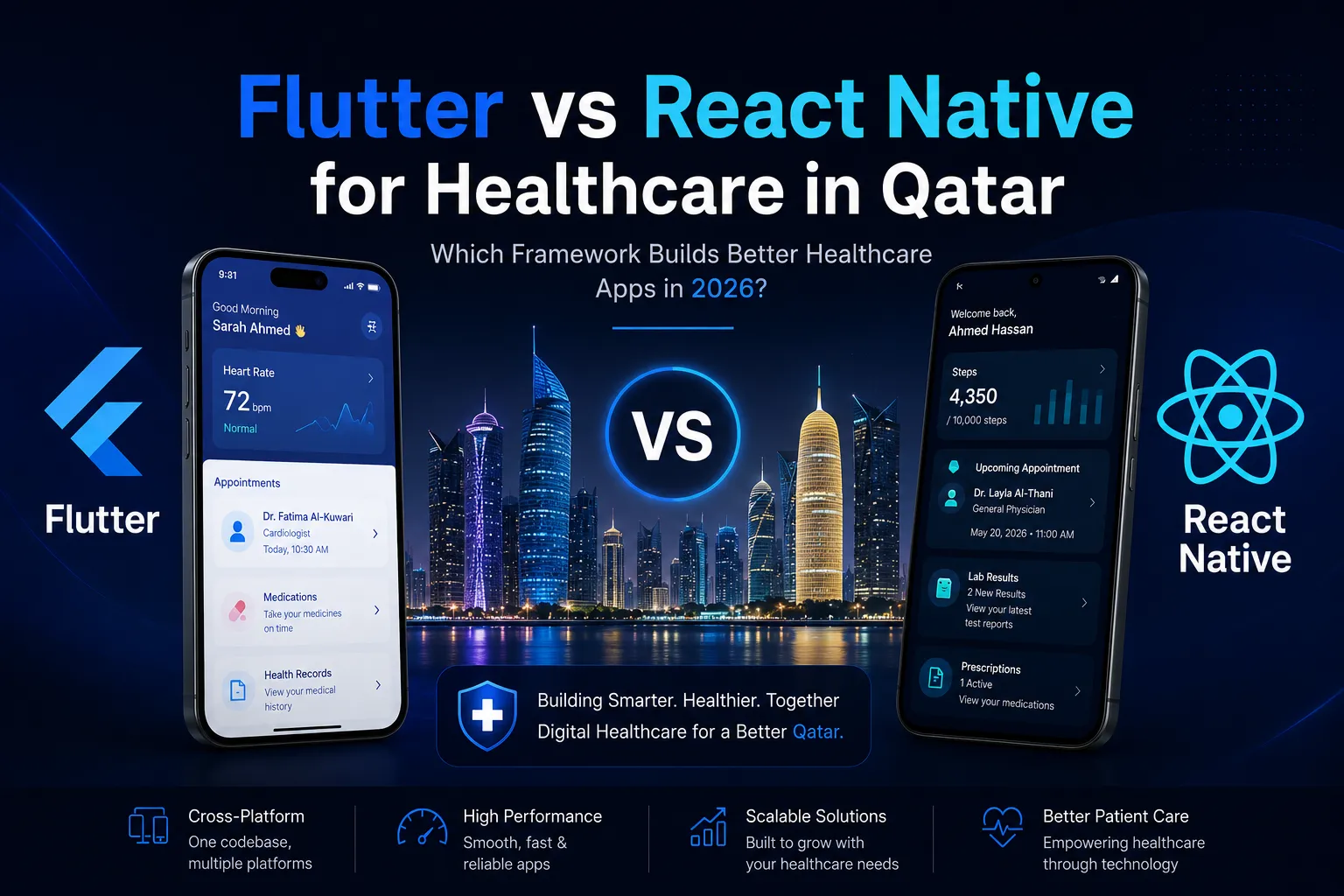
With that bias acknowledged, here's how the two stack up for healthcare apps specifically.
Where Flutter wins for healthcare in Qatar
Pixel-perfect UI consistency
Healthcare apps live or die on user trust. When a 65-year-old patient opens an appointment booking screen, the experience needs to feel calm, consistent, and reliable across every device. Flutter renders its own UI rather than using native components, which means the app looks identical on a five-year-old Android phone and a brand-new iPhone. For an audience that includes elderly patients and varying device generations — common in Qatar's diverse population — this consistency is genuinely valuable.
Arabic RTL handling
Flutter's RTL support is more mature out of the box. Building a bilingual app for Qatar's Arabic and English speakers is fundamentally easier in Flutter. Layouts mirror cleanly. Text directionality is handled at the framework level. You'll still need to design for RTL deliberately, but the framework fights you less.
I've shipped both — and the time I spent debugging RTL layout issues in React Native could have built another feature in Flutter.
Single team, two platforms, true 1:1
A small team — one or two developers — can realistically ship a high-quality iOS and Android app simultaneously in Flutter. The codebase is genuinely shared, with maybe 5% of code branching for platform-specific behavior. React Native's "write once, run everywhere" promise has more asterisks than Flutter's in practice.
For a Qatar startup or clinic where the engineering budget is QAR 100,000 rather than QAR 1 million, this matters enormously. Flutter lets a small team punch above its weight.
The compiled-language advantage
Flutter apps compile to native ARM code via Dart. This means smoother animations, less battery drain, and snappier interactions — all of which compound into the "feels professional" perception that builds patient trust. For a telehealth call screen or a real-time vitals dashboard, this performance edge can be the difference between an app that feels medical-grade and one that feels like a school project.
Where React Native wins for healthcare in Qatar
Your team already knows React
This is the single biggest reason to choose React Native. If your team is building or has built a web portal in React (which is very common for clinics that already have a patient portal), React Native lets developers move between web and mobile with minimal context-switching. The component model is familiar. The state management patterns transfer. Hiring is easier because the React talent pool in Qatar and the broader GCC is significantly larger than the Flutter talent pool.
For a clinic with an existing React-based web portal, React Native isn't even close — it's the obvious choice.
Deep native module ecosystem
When your healthcare app needs to integrate with very specific native APIs — Bluetooth medical devices, specialized sensors, hardware encryption modules, legacy SDK from a hospital information system — React Native's native module ecosystem is more mature. You'll find more existing community modules, and writing your own is well-documented.
Flutter has caught up significantly, but for the edge cases that healthcare apps frequently hit (Bluetooth glucose monitors, EHR system SDKs, biometric authentication beyond standard FaceID/TouchID), React Native still has the longer head start.
Faster hot-reload feedback loop
The development loop on React Native — make a change, see it instantly — is currently still slightly tighter than Flutter's. For prototyping rapidly with a clinic stakeholder watching over your shoulder, this matters. It lets you iterate on UX decisions in real time during stakeholder meetings.
Larger third-party ecosystem
For things like payment SDK integrations, analytics, crash reporting, A/B testing tools — most vendors ship React Native SDKs first, then Flutter SDKs months later. If your healthcare app needs to integrate with Qatar-specific payment providers or insurance systems, you'll occasionally hit "we have a React Native SDK, Flutter coming soon" situations.
The factors that should actually drive your decision
After working with both frameworks on production apps in the GCC, here is the framework I'd actually use:
Question 1: What does your existing team know?
This is the most important factor, full stop. A senior team that already knows React can ship a React Native healthcare app in 4 months. The same team learning Flutter would take 6 months and produce a worse app, because their architectural intuition wouldn't transfer.
If you have no existing team and you're hiring fresh, then look at question 2.
Question 2: How will this app integrate with your existing systems?
If you have a Laravel backend (very common in Qatar), both frameworks integrate fine via REST or GraphQL APIs. If you have a legacy hospital system with a proprietary SDK or specialized hardware, check whether that vendor has Flutter or React Native bindings before deciding.
If you're starting greenfield with a modern stack and choosing both the backend and mobile framework together, Flutter + Laravel is a combination that has matured really well — and it's the stack I've shipped multiple production systems on, including HRMS and ERP platforms for clients across Qatar, Saudi Arabia, and the broader GCC.
Question 3: Who will maintain this app in three years?
Healthcare apps are not "ship and forget" projects. The MoPH evolves its data handling guidance. iOS and Android push breaking updates. Patient expectations rise. Plan for the human who will be opening this codebase in three years to make a change, and pick the framework where finding that person is easier.
In Qatar specifically, React Native developers are slightly easier to find. Flutter developers exist but the pool is smaller. If you're planning to keep this in-house long-term, this matters.
Question 4: What's the app actually doing?
For an appointment booking app, both frameworks are completely fine. For a telehealth app with real-time video and biometric capture, Flutter's performance edge starts to matter. For an app that integrates with specialized Bluetooth medical devices, React Native's ecosystem might be the deciding factor.
The framework's strengths and weaknesses become more pronounced as the app's technical demands grow.
What Qatar's healthcare regulations actually require
A lot of "framework choice" conversations in Qatar get tangled up with confusion about MoPH (Ministry of Public Health) requirements. Let me clear this up:
The MoPH does not require a specific framework. What it requires (and what international standards like HIPAA/GDPR require, which apply for any patient data anywhere) is:
- Encryption at rest for patient data on the device
- Secure transmission (TLS 1.2+) for all patient data in transit
- Authentication and authorization that actually works — no hardcoded keys, no client-side privilege checks
- Audit logging of who accessed what patient record and when
- Data residency considerations — patient data should ideally be stored on infrastructure with appropriate residency for Qatar's regulatory environment
- Consent and data subject rights — patients need to be able to access, export, and (in some cases) delete their data
All of this is achievable in both Flutter and React Native. The hard work is in the architecture and the backend, not the framework.
If a developer or agency tells you "Flutter is more compliant than React Native for healthcare in Qatar" — be skeptical. They're probably not thinking carefully about what compliance actually means.
My honest recommendation framework
After years of building this kind of system for clients in Qatar and the GCC, here is the decision tree I'd actually use:
Choose React Native if any of these are true:
- You have an existing React web team
- Your app needs deep integration with legacy SDKs
- You need to ship rapidly with a developer who already knows React
- Your roadmap includes significant integration with Qatar-specific third-party SDKs (payment, insurance, EHR vendors)
Choose Flutter if any of these are true:
- You're starting greenfield with a small team
- The app needs rich, custom UI and animations
- Arabic and English bilingual experience matters a lot to your audience
- You want maximum code sharing between iOS and Android
- Performance is a primary differentiator (telehealth, real-time data)
Choose native (Swift + Kotlin) if:
- The app is genuinely platform-specific (deeply iOS or Android only)
- You have separate, well-funded iOS and Android teams
- You need cutting-edge native features the moment they ship
For 80% of healthcare apps I see in Qatar, Flutter is the right answer because most clients are small teams starting greenfield with a bilingual audience and a modest budget. But your context might land you in the 20% where React Native or native is the better fit.
The thing that matters more than the framework
I want to end with this because it's the truth most consultants won't tell you: the framework you pick won't make your healthcare app succeed. Architecture decisions, data handling discipline, and post-launch support will.
I've seen beautifully built Flutter apps fail because the backend was an afterthought and the team had no plan for the first MoPH audit. I've seen messy React Native codebases ship successful healthcare products because the architects took data security seriously and the founder was disciplined about iterative improvement.
If you spend three months agonizing over Flutter vs React Native and one week thinking about your data architecture, you've got your priorities exactly backwards. Pick the framework that matches your team and context, then spend your energy on the decisions that actually determine outcomes.
If you're working on a healthcare app for the Qatar market and want a senior engineer's perspective on your architecture, your stack choice, or your compliance approach, I take on a small number of senior consulting engagements each quarter. You can also see how I've approached this kind of build in my portfolio case studies, or get in touch directly through the contact page.
Either way — pick the framework that lets you focus on the work that matters. The rest is noise.