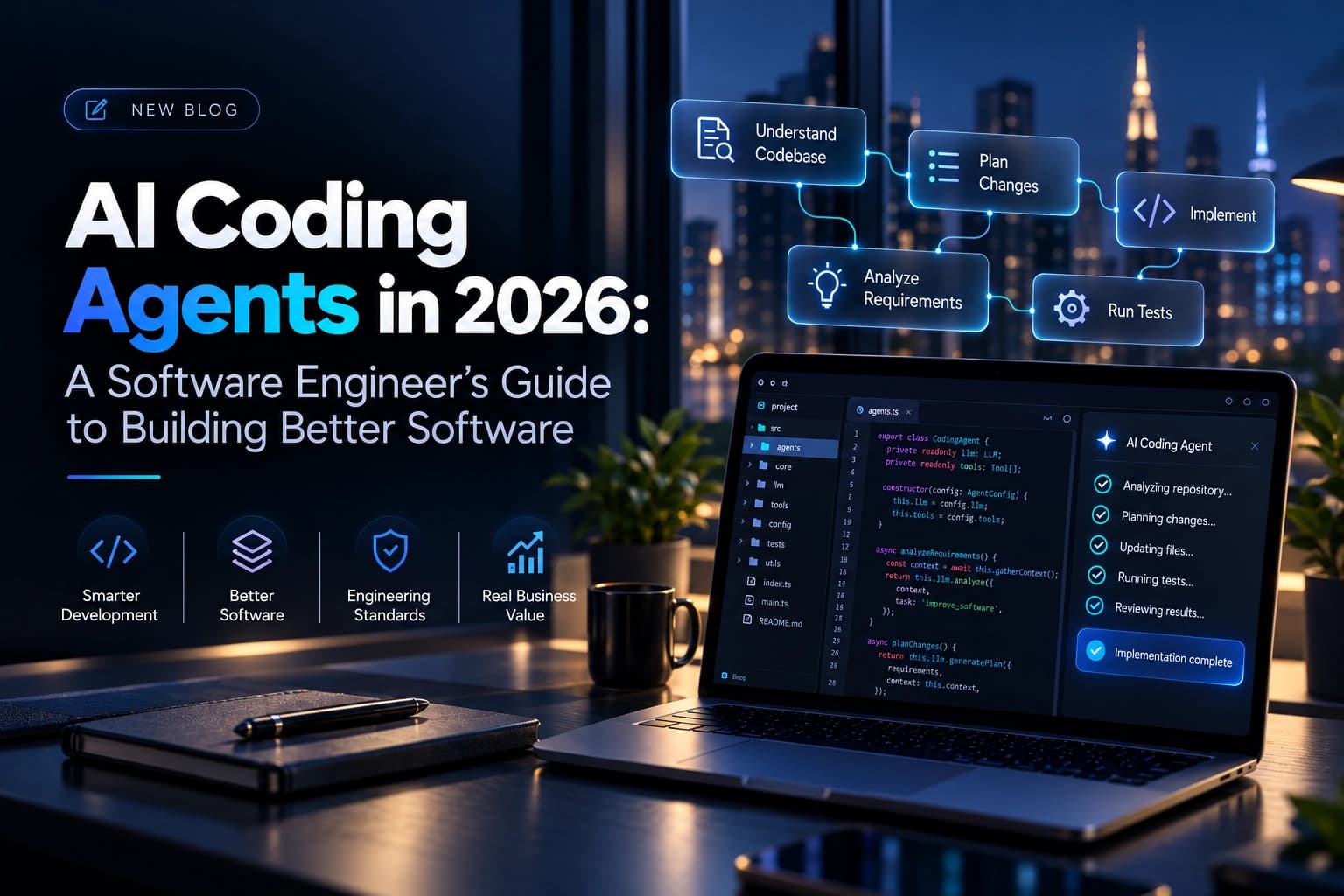
For most of the last decade, AI in the editor meant autocomplete. You typed, and a model guessed the next few lines. Useful, but narrow. The current generation does something different. It can read a whole repository, plan a change, edit several files, run the test suite, read the failures, and try again.
That shift has a name now: agentic coding. Most of the talk around it lands in one of two camps. One says software engineers are about to be automated away. The other says these tools are toys that produce code no serious team would ship. Both are wrong. AI coding agents do not remove engineering from software. They move the effort toward deciding what to build, how to structure it, and whether what came back is actually correct.
This guide is for engineers and the people who hire them. It covers what an agent actually is, where it helps, where human judgment is still non-negotiable, and how the job changes for junior and senior developers.
From autocomplete to agents
Three things often get lumped together, so it helps to separate them.
Autocomplete predicts code as you type. You control every line.
An assistant answers a question or generates a snippet when you ask. You are still in the loop for each step.
An agent is different in kind. You give it a goal and some context, and it inspects the repository, reasons across files, makes changes, runs tests, reads the output, and keeps going until the task is done or it gets stuck. The loop closes around the model instead of around you.
That last part, acting and then checking its own work, is what makes it an agent:
Engineering goal
      |
Context + constraints
      |
AI coding agent
      |
Inspect repository
      |
Plan changes
      |
Implement
      |
Run tests / validate
      |
Engineer review
The agent runs the inner loop. The engineer owns the outer one.
Why this became real in 2026
Agentic coding did not arrive on a single breakthrough. A few things matured at once.
Context windows grew large enough to hold real parts of a codebase, so a model can reason about how a change ripples through related modules instead of guessing from one file. Reasoning got good enough that multi-step tasks hold together instead of falling apart halfway. And the tools gained access: a terminal, test execution, version control, and a way to call external systems.
Standardized tooling is a good example. The Model Context Protocol started as an Anthropic specification for connecting models to external tools, and it moved to the Linux Foundation in late 2025 with backing from AWS, Google, Microsoft, and OpenAI. The practical effect is that an agent can reach your database, issue tracker, or docs through one common interface instead of a dozen custom integrations.
Agents also moved into the places engineers already work. GitHub now runs Claude and Codex as coding agents that can take an assigned issue, work in an isolated environment, and come back with a draft pull request. Terminal-based agents run in the shell against a local checkout. The pattern is always the same: a longer task, real tools, human review at the end.
Where agents actually help
Past the demos, the tasks that pay off share one trait. The intent is clear, and the result is cheap to check.
- Reading an unfamiliar codebase and tracing how a feature flows through it.
- Repetitive implementation where the pattern already exists.
- Writing tests, including the edge cases people skip when they are tired.
- Mechanical refactors and library migrations across many files.
- A first pass at reproducing a bug and narrowing down where it lives.
The limit is the mirror image of the strength. When the intent is vague, or correctness is expensive to verify, agents struggle. They are strong on known problems with clear signals and weak on novel problems with fuzzy requirements. An agent can implement a caching layer. Deciding whether you need one, and what it must never do, is still your call.
Generating code and engineering a system are not the same problem
This is the part the hype skips. Writing source code is one task inside engineering, and not the hardest one.
A reliable system is defined by decisions that live outside the code an agent writes. Where the architecture boundaries sit. How the data model will age. Which failure modes are acceptable and which are not. How it scales when traffic is uneven. Who can reach user data. How the whole thing gets deployed, observed, and recovered when it breaks at 2am.
None of that is a prompt. It is judgment applied to a specific business. An agent can implement a decision quickly, but it cannot own the decision, because it does not carry the consequences. It is also why the same prompt is excellent in one repository and quietly dangerous in another. The difference is the engineering context around it, not the model.
I have written separately about choosing a backend stack for enterprise work and about designing admin systems that survive real operations. Neither is a decision to hand to an agent alone.
What the workflow actually looks like
In practice the agent sits in the middle of a process that engineers still own on both ends.
Business requirement
        |
Engineer analysis
        |
Architecture / technical plan
        |
Context provided to the agent
        |
Agent-assisted implementation
        |
Automated tests
        |
Engineer code review
        |
Security / edge-case validation
        |
Deployment and monitoring
Read it top to bottom and the engineer's role is obvious. The work before the agent decides whether the code is even aimed at the right target. The work after it decides whether it is safe to ship. The agent compresses the middle. It does not remove the ends.
Context is becoming a real skill
The biggest lever on output quality is not the model you pick. It is the context you give it.
An agent working from clear conventions, API contracts, a described data model, and explicit constraints produces work that fits. The same agent working from a vague one-line request produces something that runs and quietly breaks three assumptions nobody wrote down.
This is why context engineering is turning into actual work: deciding what the agent needs to know, writing it down in a usable form, and keeping it current. It happens to be the same work that makes a codebase easy for new human engineers to join. That is not a coincidence.
Faster code makes architecture more important, not less
If code is cheaper to produce, it is tempting to assume structure matters less. The opposite holds.
Generate twice as much code on a weak architecture and you get technical debt twice as fast. Volume amplifies whatever it lands on. When implementation speeds up, the parts that do not speed up on their own become the real constraint: consistent boundaries, review standards, documentation, observability, and automated tests.
So agents raise the value of the things senior engineers were already responsible for. Teams that invested in clean system architecture get faster. Teams that did not get a bigger mess, sooner.
Security and trust boundaries
Give a process the ability to run commands, read a repository, reach a database, touch secrets, and deploy, and you have described both a capable agent and a real attack surface. The response is ordinary security engineering.
Least privilege comes first: the narrowest access that lets the agent do the task, and nothing more. Actions with real consequences, such as production writes, secret rotation, and deploys, stay behind human approval rather than inside the agent's loop. Work happens in sandboxed or throwaway environments where possible. Secrets stay out of prompts. And because agents read text from issues, docs, and dependencies, prompt injection is a genuine risk: content the agent reads can try to steer what it does, so the line between data to analyze and instructions to follow has to be enforced on purpose.
Treat an agent like any other automated identity with credentials. Scoped, logged, reviewed.
Juniors and seniors
The fundamentals matter more, not less. Their role just shifts.
Junior developers
The temptation is to let the agent handle the parts that are hard to learn. That is the one thing not to do. Programming fundamentals, debugging, data structures, how APIs and databases actually behave, Git, and testing are what let you tell whether generated code is right. An engineer who cannot review the agent is not in control of the software. Used well, an agent is one of the best learning tools around, since you can ask it to explain its own changes. Used as a crutch, it stalls the exact skills that make you employable.
Senior engineers
The high-leverage skills get more valuable: system design, decomposition, reviewing generated changes critically, security, domain knowledge, setting the constraints an agent works inside, and mentoring. These responsibilities still need an accountable engineer, even when an agent assists with them. The role bends toward direction and quality, and away from being the fastest typist on the team.
Does this replace software engineers?
Worth answering plainly, since it is what people type into search.
Engineering is the full loop: understand the problem, translate messy requirements into something buildable, make trade-offs, design a system, build it, validate it, and operate it over time. Agents accelerate parts of that, mostly the implementation and some of the validation. They do not own the loop.
We have been here before. Higher-level languages, frameworks, cloud platforms, and CI/CD each removed a layer of manual work, and each raised what a single engineer could be responsible for. Nobody says compilers replaced programmers. They changed what programming meant. Agentic tooling is the same kind of change. Anyone certain about where it lands in ten years is guessing. What is clear today is narrower and more useful: the work is moving up a level, not disappearing.
What to learn, and what "better" means
If you are deciding where to put your attention, the list is not surprising. Get fluent with agent workflows and with giving them good context. Deepen system design, API design, and automated testing. Take security, DevOps, cloud, and observability seriously. Learn how tool integrations work. And keep investing in domain knowledge, the one advantage no model ships with. I distinguish this development workflow from integrating AI features into a product: using an agent to write code and shipping an AI capability are different responsibilities.
Underneath all of it is one question: what is the goal? If the goal is simply more code, agents will happily help you produce more of the wrong thing. The better goal is to spend the saved time on the parts that were always hard: architecture, product decisions, reliability, and understanding the domain.
The strongest teams over the next few years will not be the ones whose agents write the most code. They will be the ones who pair capable tools with judgment that stays human, and who remember that someone is still accountable when the software is running in front of real users. That someone is an engineer.
My core work remains Flutter applications, Laravel backends, and system architecture. I use AI tools to extend that work into web development and to support implementation, with responsibility for the technical decisions and the result. More about how I work.